
Understanding ACORD® 103 in Life and Annuity Insurance
Introduction
In the life and annuity insurance industry, data consistency and operational precision are not optional. Every transaction, from policy issuance to fund transfers and ownership changes, depends on structured documentation that can be interpreted reliably across carriers, advisors, and administrative systems. As insurance products have become more complex and increasingly digital, the need for standardized data exchange has only grown stronger.
This is where ACORD standards play a foundational role. Developed by the Association for Cooperative Operations Research and Development, ACORD provides a common language for insurance data, allowing different systems and organizations to communicate in a consistent and predictable way. Within this framework, various standardized forms support different insurance functions across property, casualty, life, and annuity lines of business.
In life and annuity insurance, ACORD forms are especially important because they underpin transactions that often involve long-term financial commitments, tax implications, and regulatory oversight. Legacy systems and internal carrier architectures often reference structured formats such as ACORD 103 to represent standardized life and annuity data elements used in applications, processing workflows, and administrative integrations.
Understanding ACORD 103 in this context requires stepping back from the idea of a single static form and instead recognizing it as part of a broader data standardization approach that enables life and annuity systems to function efficiently at scale.
The Role of ACORD Standards in Insurance
ACORD was created to solve a long-standing problem in insurance: fragmentation. Historically, each carrier used its own forms, terminology, and documentation structure. Advisors and brokers were forced to navigate different requirements for every carrier, leading to inefficiencies, data errors, and delays in processing.
ACORD introduced standardized forms and data definitions to eliminate this fragmentation. Instead of reinventing documentation for every transaction, carriers could rely on a shared structure that defines how insurance information should be captured and transmitted. Over time, these standards evolved from paper-based forms into digital data models used in APIs, integration platforms, and enterprise systems.
In modern insurance environments, ACORD standards are no longer just about forms. They represent a data interoperability layer that allows life carriers, annuity providers, distributors, and technology platforms to exchange structured information without constant reformatting or manual interpretation. This evolution is particularly important in life and annuity insurance, where transactions are often multi-step, heavily regulated, and financially sensitive.
Life and Annuity Insurance and the Need for Structured Data
Life and annuity products differ from other insurance lines in both complexity and duration. These are long-term financial instruments that involve policyholder identity verification, investment allocation decisions, beneficiary designations, and often tax advantaged structures. Because of this, the data required to process a single transaction can be extensive and highly detailed.
A small inconsistency in a policyholder’s information or a missing field in a transfer request can delay processing or trigger compliance issues. For this reason, carriers rely on structured formats that ensure all required information is captured correctly and consistently.
ACORD forms in life and annuity insurance serve as structured templates for this purpose. They define how data should be collected, how it should be validated, and how it should be transmitted between parties and systems. In this ecosystem, ACORD 103 is often associated with structured data elements used in life and annuity application and administration workflows within carrier systems, even when it is not directly visible to end users.
What matters most is not the form number itself, but the role it plays in ensuring that life and annuity data is standardized and interoperable across the insurance value chain.
Understanding ACORD 103 in Practice
Within insurance operations, ACORD 103 is best understood as part of a structured data model used to support life and annuity processing workflows. In many legacy systems and internal architectures, it functions as a template or schema that defines how certain policy or transaction data should be captured and organized.
Rather than being a consumer-facing document, it often exists behind the scenes within insurance administration systems. It helps ensure that data entered by advisors, brokers, or digital platforms is consistently mapped into carrier systems without ambiguity.
In practical terms, ACORD 103-type structures may support functions such as policy applications, administrative updates, or integration between external distribution channels and internal processing systems. Its purpose is to provide structure, reduce variation, and support downstream automation. As insurance systems modernize, many of these structured formats are being embedded into APIs and digital workflows, but the underlying principle remains the same: insurance data must be standardized to be usable at scale.
The Operational Challenges of Traditional ACORD Processing
Despite the benefits of standardization, many carriers still rely heavily on manual processing of ACORD based documents. In traditional workflows, advisors complete forms, often in PDF format, which are then submitted to carriers for review and re-entry into internal systems.
This creates several operational challenges. Manual data entry introduces the possibility of errors, especially when forms are complex or contain multiple sections. Incomplete submissions require back-and-forth communication between carriers and advisors, which slows down processing times. In addition, different interpretations of form fields can lead to inconsistencies in how data is recorded across systems.
These inefficiencies are particularly problematic in life and annuity insurance because transactions often involve significant financial values and regulatory scrutiny. Even small delays can impact customer satisfaction, advisor productivity, and carrier operational costs. As a result, carriers have been seeking ways to reduce manual intervention and move toward more automated, intelligent processing models.
How System Intelligence Is Transforming ACORD 103 Processing
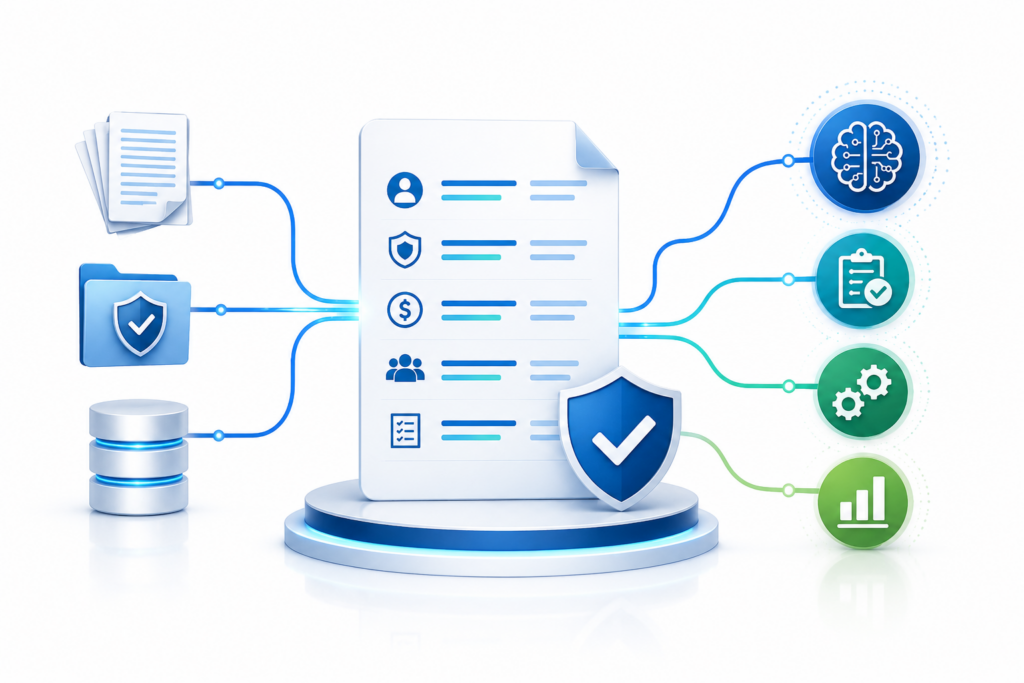
System intelligence is rapidly reshaping how carriers can process ACORD 103 transactions by moving validation from a manual, reactive activity to an automated, proactive discipline. ACORD 103, which governs premium and remittance data exchange, is foundational to insurance operations, but also highly sensitive to data errors. Even small inconsistencies in XML messages can lead to downstream processing failures, delays, and compliance risks. Traditional approaches, heavily reliant on manual QA and “sanity checks,” are no longer sufficient in a high-volume, digital-first environment.
At its core, system intelligence introduces automation and embedded domain knowledge into the validation process. Instead of relying on human inspection, system intelligence continuously analyze transaction data as it moves between systems, comparing expected and actual outcomes in real time. Emtech has been at the forefront of this shift, enabling organizations to validate 100% of transient data automatically. This eliminates the traditional “stare and compare” approach and significantly reduces the risk of undetected defects in ACORD 103 processing.
A key transformation driven by system intelligence is the shift-left of quality assurance. Intelligent validation engines detect data defects earlier in the software development lifecycle, rather than after deployment or during downstream processing. This early detection is critical in ACORD 103 workflows, where errors can cascade across billing, underwriting, and financial reconciliation systems. By embedding validation into continuous testing cycles, carriers can dramatically shorten QA timelines while improving overall data integrity and compliance.
Another important dimension is the move toward model-based and no-code automation. System intelligence platforms leverage structured data models and business rules specific to insurance standards like ACORD 103. This allows business analysts, not just developers, to define validation logic using domain language rather than code. Solutions developed by Emtech demonstrate how this approach bridges the gap between business expertise and technical execution, enabling scalable, repeatable validation without the maintenance burden of script-based automation.
System intelligence also enhances operational efficiency and business outcomes. By continuously validating XML transaction data and generating detailed, actionable reports, carriers can quickly identify and resolve defects, reduce Not-In-Good-Order (NIGO) rates, and improve partner satisfaction. Automated validation ensures that data completeness and accuracy are maintained across complex ecosystems, allowing carriers and Insurtechs to accelerate product launches and drive top-line growth with confidence.
Ultimately, system intelligence is transforming ACORD 103 processing from a bottleneck into a competitive advantage. With intelligent validation engines, carriers can achieve continuous data assurance, reduce operational risk, and scale their digital initiatives more effectively. Emtech’s innovations in this space highlight how combining automation, domain-specific intelligence, and real-time validation is redefining quality engineering in insurance, turning data integrity into a strategic enabler rather than a persistent challenge.
Business Impact of Intelligent ACORD Processing
The adoption of system intelligence for ACORD processing has a direct impact on insurance operations. Processing times are significantly reduced because manual review steps are minimized. Operational costs decrease as fewer resources are required for data entry and rework. Data accuracy improves because automated validation reduces human error. Customer and advisor experiences improve because transactions move faster and with fewer interruptions.
In addition, carriers gain stronger compliance capabilities because rules are enforced consistently and automatically across all submissions. This reduces regulatory risk and improves audit readiness. Over time, these improvements contribute to a more scalable and resilient operational model, particularly important for carriers managing large volumes of life and annuity transactions.
The Future of ACORD 103 and Insurance Data Systems
The future of ACORD standards is closely tied to the broader digital transformation of the insurance industry. As carriers continue to modernize their systems, traditional document based workflows are being replaced by API driven data exchange and real-time processing architectures.
In this environment, ACORD 103 type structures will increasingly exist not as static forms but as dynamic data models embedded within digital platforms. Insurance transactions will be initiated, validated, and processed entirely through interconnected systems without the need for manual form handling.
AI will play an increasingly central role in this transformation, not only extracting and validating data but also optimizing workflows and supporting decision-making. The result will be an insurance ecosystem where data flows seamlessly between advisors, carriers, and policy systems with minimal friction.
Final Thoughts
ACORD 103, when viewed within the broader context of life and annuity insurance, represents more than just a form or data structure. It reflects the industry’s ongoing need for standardized, reliable, and interoperable insurance data. While traditional ACORD based workflows have historically relied on manual processing and document handling, the industry is rapidly shifting toward intelligent automation and real-time data processing.
As carriers adopt AI-driven systems and modern integration architectures, ACORD data is becoming more dynamic, more accessible, and more deeply embedded in operational workflows. This shift is not just improving efficiency but fundamentally reshaping how life and annuity insurance is administered. In this evolving landscape, the combination of ACORD standards and system intelligence is defining a new era of insurance operations, one that is faster, more accurate, and significantly more scalable than what came before.
To read more about System Intelligence, Quality Assurance, QMT, QMT TruePDF, QMT TrueXML, and technology topics, visit our blog or visit our resource center. Try QMT TruePDF for free – click here. Book a demo here.
About the Author
Neil Bendov, MBA, is a VP of Marketing at Emtech. He is a seasoned marketing professional driven by a passion for cultivating brand success. With a diverse background and a track record of delivering results, Neil specializes in creating and executing innovative business-to-business marketing strategies that resonate with target audiences. Armed with a keen understanding of customer behavior and market trends, he has successfully navigated the dynamic landscape of digital and traditional marketing channels.