
From Testing to System Intelligence
Introduction
In today’s fast-moving digital world, enterprise software systems are the backbone of business operations. From customer-facing applications to complex back-office platforms, organizations depend on these systems to deliver accurate, reliable, and timely outcomes. Yet, despite heavy investments in software and testing, many enterprises struggle to fully understand how their systems behave.
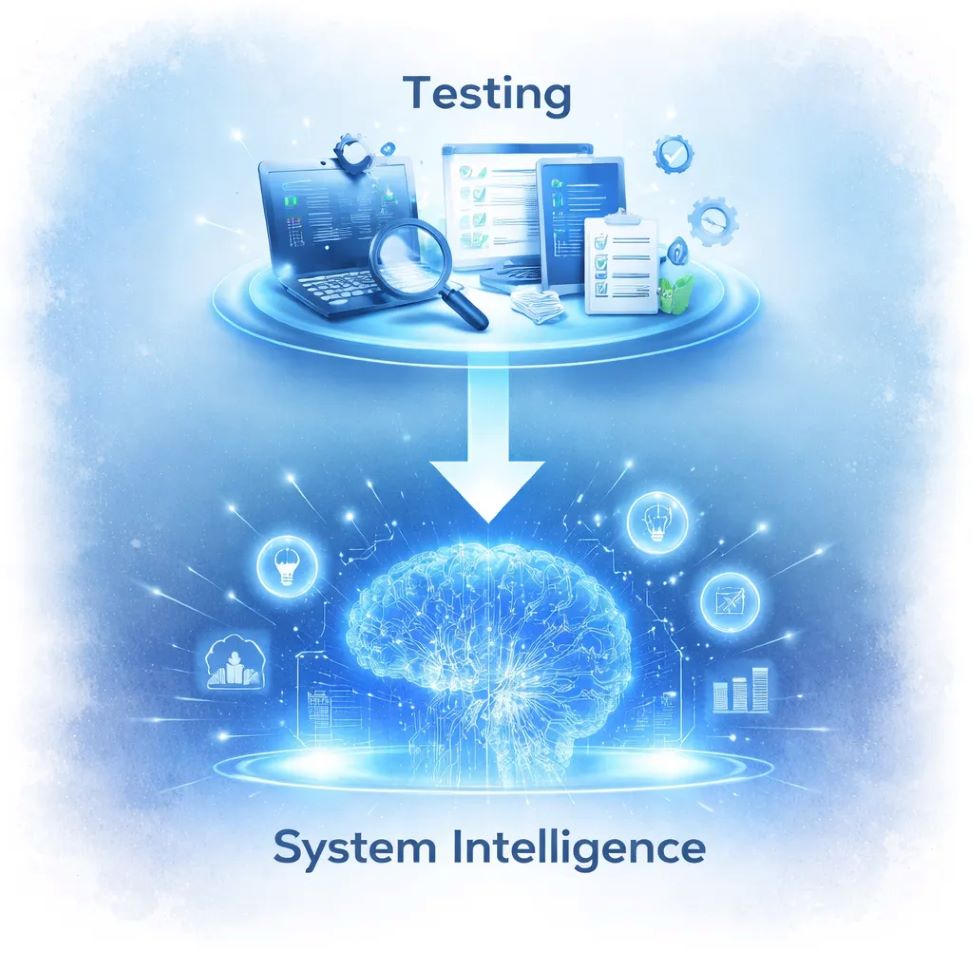
Traditional testing methods, manual QA, scripted automation, and periodic validation cycles, were designed for a simpler era. These approaches assume systems are predictable, stable, and fully documented. But modern enterprise systems are anything but. They span legacy platforms, cloud services, APIs, third-party integrations, and highly complex business rules.
As a result, organizations face challenges that testing alone cannot solve gaps in system knowledge, slow-release cycles, hidden dependencies, and compliance risks. Recognizing these challenges, Emtech has pioneered a new approach: System Intelligence. This method moves beyond traditional testing, providing continuous insight into system behavior and enabling enterprises to validate and understand their software at a fundamental level.
From Understanding Systems to Enabling AI
As organizations accelerate AI adoption, they face a common obstacle: AI is only as effective as the information it can access and understand. In most enterprises, critical knowledge is scattered across applications, documentation, configuration files, business rules, and the expertise of a handful of experienced employees. Without a complete and accurate understanding of how these systems work together, AI can produce incomplete, inconsistent, or unreliable results.
This challenge inspired the next stage of Emtech’s innovation. Building on years of research in model-based and autonomous testing, Emtech developed QMT Oracle that automatically creates a Digital Blueprint of complex enterprise applications. Rather than relying on manually maintained documentation, QMT Oracle discovers how applications actually behave, capturing workflows, business rules, system dependencies, user interactions, and supporting assets in a living, machine-readable model.
The result is a trusted foundation that not only improves software quality but also provides the contextual intelligence required for enterprise AI.
The Complexity Problem: Why Traditional Testing Is No Longer Enough
Modern enterprise systems are highly interconnected and constantly evolving. New features, integrations, and business logic are added daily. For QA teams, this creates a moving target that is impossible to fully cover with traditional test cases.
Manual testing depends heavily on human assumptions and predefined scripts. Even automated tests are limited by their scope. They can only validate scenarios that are already known. This leaves organizations exposed to unforeseen issues, hidden dependencies, and regressions that may only appear in production.
In regulated industries such as insurance the stakes are even higher. Systems must comply with strict regulations, and errors can result in significant financial, operational, and reputational risk. In these environments, partial system knowledge is a serious liability.
The Shift to System Intelligence
System Intelligence represents a fundamental change in how enterprises approach software validation. Instead of testing systems piece by piece, it focuses on continuously understanding how the system behaves.
QMT Oracle is the platform that enables this transformation. It continuously analyzes enterprise applications to build and maintain a Digital System Blueprint that captures workflows, business rules, integrations, dependencies, and user interactions. Rather than relying on static documentation or manually maintained models, organizations gain a living representation of how their systems actually operate. This Digital Blueprint becomes the foundation for continuous validation, intelligent automation, and enterprise AI.
At the heart of this approach is the Digital System Blueprint. Unlike static documentation, which quickly becomes outdated, the blueprint is a living, continuously updated model of the system. It captures every workflow, dependency, and business rule, providing teams with full visibility into how the system operates in real time.
By leveraging the blueprint, organizations can ask questions beyond “Did we test this scenario?” They can ask “Do we fully understand how our system behaves?” This shift enables proactive validation, reduces risk, and creates a foundation for faster, more confident decision-making.
Emtech’s Autonomous Model Generation (AMG)
A core capability of QMT Oracle is Autonomous Model Generation (AMG). AMG automatically analyzes enterprise applications and generates a complete Digital Blueprint that reflects actual system behavior. Rather than simply automating test execution, AMG continuously discovers workflows, business logic, integrations, user journeys, and dependencies, ensuring the blueprint always reflects the current state of the application.
Because AMG continuously updates the Digital Blueprint as applications evolve, QMT Oracle eliminates the need for manually maintained documentation and incomplete system models. Every application change is automatically reflected, providing development, QA, and business teams with an accurate understanding of the system throughout its lifecycle.
With AMG, validation becomes autonomous and intelligent. Teams can detect defects earlier, understand the impact of changes instantly, and make data-driven decisions with confidence.
Continuous Validation for Modern Systems
One of the most transformative aspects of System Intelligence is continuous validation. Traditional QA methods operate in cycles: test, release, and repeat. This approach often leads to bottlenecks, slow-release cycles, and reactive problem-solving.
System Intelligence changes that paradigm. Through QMT Oracle, continuous validation is performed against the Digital Blueprint instead of isolated test scripts. Every application change is evaluated within the context of the entire system, allowing organizations to understand not only whether functionality works, but also how changes affect downstream processes, integrations, compliance rules, and business operations. By continuously validating the system against the Digital Blueprint, teams gain immediate insight into whether changes behave as intended. This always on approach catches regressions early, reduces the need for large-scale testing cycles, and accelerates the release of updates without compromising quality.
Continuous validation also enables enterprises to respond faster to regulatory changes. In industries where compliance is critical, being able to validate every workflow and business rule in real time is a major advantage.
Enabling Smarter Automation and AI
QMT Oracle also serves as the knowledge layer that enables enterprise AI. Traditional AI initiatives often struggle because they lack a complete understanding of enterprise applications. By providing AI with an accurate Digital Blueprint of system behavior, workflows, business rules, and dependencies, QMT Oracle supplies the trusted context required for reliable AI-assisted analysis and decision-making.
Rather than asking AI to infer how systems work from fragmented documentation, organizations can leverage QMT Oracle to provide verified system knowledge. This enables AI to perform more accurate change impact analysis, root cause investigation, requirements validation, automated test generation, and modernization planning.
This makes AI not just a tool for experimentation but a practical capability that improves system reliability, efficiency, and insight. Automation becomes adaptive rather than static, capable of adjusting to changes in the system automatically.
Transforming QA Into a Strategic Advantage
System Intelligence is more than a technical improvement, it is a strategic capability. By providing complete visibility into system behavior, organizations can reduce risk, accelerate delivery, and increase operational confidence. Because QMT Oracle continuously maintains the Digital Blueprint, it becomes a shared source of truth across QA, development, architecture, operations, and business teams. Instead of relying on different documentation and assumptions, everyone works from the same continuously updated understanding of the enterprise application.
In practical terms, this means fewer defects reaching production, faster time-to-market for new features, and improved compliance auditability. It also fosters collaboration across teams, aligning QA, development, operations, and business units around a single, shared model of the system.
The Digital Blueprint becomes a central reference for innovation. Teams can safely modernize systems, integrate new technologies, and adopt AI-driven processes without fear of unexpected consequences. In this way, understanding the system moves from a technical requirement to a competitive business advantage.
Real-World Impact in Insurance
In insurance, System Intelligence has a direct impact on both operational efficiency and risk mitigation. Insurance carriers, for example, often manage hundreds of interconnected workflows, policy rules, and data exchanges. A single misconfiguration can lead to processing errors, compliance breaches, and customer dissatisfaction.
Using QMT Oracle, insurance carriers gain continuous visibility into policy administration systems, claims platforms, billing applications, and customer service workflows. The Digital Blueprint automatically identifies business rules, dependencies, and integration points, allowing organizations to validate complex processes continuously while reducing compliance risk and accelerating product delivery.
Preparing for the Future of Enterprise Systems
As enterprise software grows in complexity, the limitations of traditional QA become increasingly clear. System Intelligence represents the future of validation: holistic, continuous, and adaptive.
Organizations that adopt this approach can validate changes in real time, leverage AI effectively, and understand their systems at a level that was previously impossible. System Intelligence transforms validation from a reactive task into a strategic capability that supports faster innovation, higher quality, and lower operational risk.
QMT Oracle: The Foundation of System Intelligence
Throughout this journey, QMT Oracle serves as the technology that transforms System Intelligence from a concept into an operational capability. By continuously creating and maintaining a Digital System Blueprint, it provides organizations with an accurate, machine-readable understanding of enterprise applications that traditional documentation and testing alone cannot achieve.
This trusted system knowledge becomes the foundation for continuous validation, intelligent automation, and enterprise AI. Rather than relying on assumptions or outdated documentation, organizations can leverage QMT Oracle to understand how applications behave today, predict the impact of future changes, and confidently modernize complex enterprise environments.
With a trusted Digital Blueprint, organizations can apply AI across critical business initiatives, including:
- Change impact analysis
- Root cause analysis
- Requirements validation
- Knowledge management
- Automated test generation
- Application modernization
- Business process understanding
By connecting AI with a trusted understanding of enterprise systems, QMT Oracle helps organizations move from AI experimentation toward practical, enterprise-scale adoption.
Final Thoughts
For decades, enterprises have responded to increasing software complexity by investing in more testing. While testing remains essential, it cannot provide complete system understanding. QMT Oracle changes that equation by delivering System Intelligence through a continuously evolving Digital System Blueprint. Organizations gain a trusted understanding of how their applications function, enabling continuous validation, intelligent automation, AI readiness, and more informed business decisions.
In an era where software defines the business, understanding your system is no longer optional. It is the foundation of operational excellence, regulatory compliance, and competitive advantage. System Intelligence ensures that organizations are not just testing software, they are truly understanding it.
To read more about System Intelligence, Quality Assurance, QMT, QMT TruePDF, QMT TrueXML, and technology topics, visit our blog or visit our resource center. Try QMT TruePDF for free – click here. Book a demo here.
About the Author
Neil Bendov, MBA, is a VP of Marketing at Emtech. He is a seasoned marketing professional driven by a passion for cultivating brand success. With a diverse background and a track record of delivering results, Neil specializes in creating and executing innovative business-to-business marketing strategies that resonate with target audiences. Armed with a keen understanding of customer behavior and market trends, he has successfully navigated the dynamic landscape of digital and traditional marketing channels.